Resistance isn’t the enemy—it’s part of the path. Learn how to shift your relationship with it and turn resistance into power, purpose, and momentum.


Turn resistance into power!
My wife was in the kitchen making dinner and I walked through, with a troubled look on my face. “What’s up?” she asked. “Oh, I have to write this blog and I’m really not in the mood.” She was curious. “A blog entry? What’s it about?” “Resistance!” I answered, and we both burst out laughing…
I talk a lot about setting goals and going after your dreams. I am not unaware of the challenges of change, and even the burden of success and failure. Action implies risk. As I was thinking about writing this piece, several negative thoughts went through my head. “It’s going to be a lot of work!” was the first one. “What if it isn’t good?” was another. I think back to a couple of stinkers I’ve written and it brings up a little fear and even some embarrassment. I think to myself “Nobody reads this stuff anyway!” Before I know it, I’m judging myself and my writing, and I want to do it, even less! “Who am I to be pontificating?” Yeah, now my resistance is in full swing! I not only don’t want to do it, I’m angry about it!
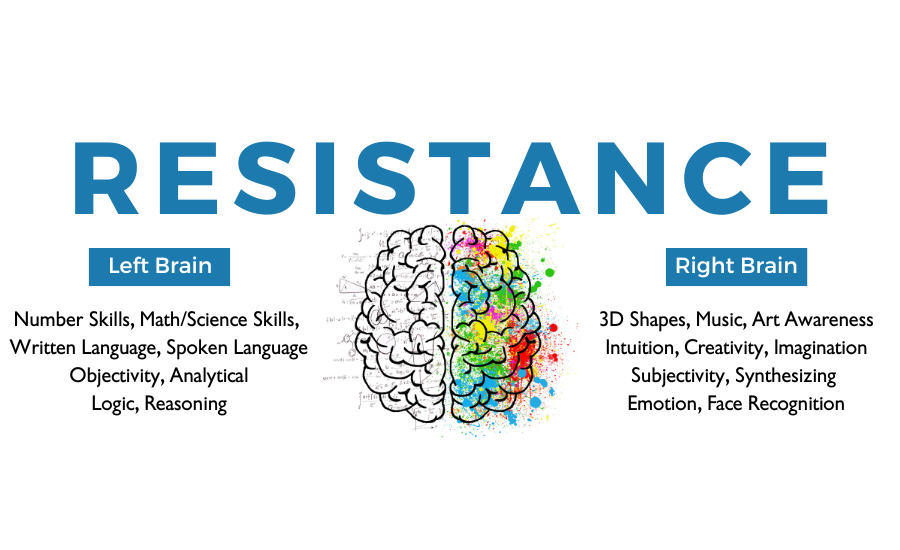
This ego, this identity of ours is a vicious defender. It will concoct any concept, perception or story to steer us away from change. The amygdala—a roughly almond-shaped mass of gray matter inside each cerebral hemisphere, involved with the experiencing of emotions, is a part of your brain that interprets change as a threat and releases the hormones for fear: fight or flight. Your body is actually protecting you from change. It senses danger, but what is the danger it senses?
We enjoy the comfort and safety of sameness, the predictability of the expected. We understand our present set of circumstances and have built reality around those circumstances. In addition, we have created neural networks to deliver the neurotransmitters and the neurochemistry that we are habituated to.
When we set a goal and start out toward it, we know change is coming and it is a threat on many different levels. Change signals loss of control and danger. Scary!
It’s not that there isn’t value in resistance. In electronics, resistance is essential to power. In fact, the less resistance, the less power. Take that in: resistance is essential to power. In human terms, when you are the resistor, you can have enormous power. Mahatma Ghandi revolutionized an entire country and ultimately the world, through his resistance. Resistance Training is based on using resistance in order to build muscle and increase power.
So, how can we find use in resistance? I think the first order of business is to examine our relationship to resistance. Here are some questions to ask in order to define how you experience it:
After seeing what your relationship to your resistance is about, you can start to take steps to overcome it.
With all of this in mind, I decided a specific time that I would work on it, visualized it being done, made myself a nice cup of tea, put on some sweet background music, and told my wife when I would be done. Now I’m off to the races!!


Comments